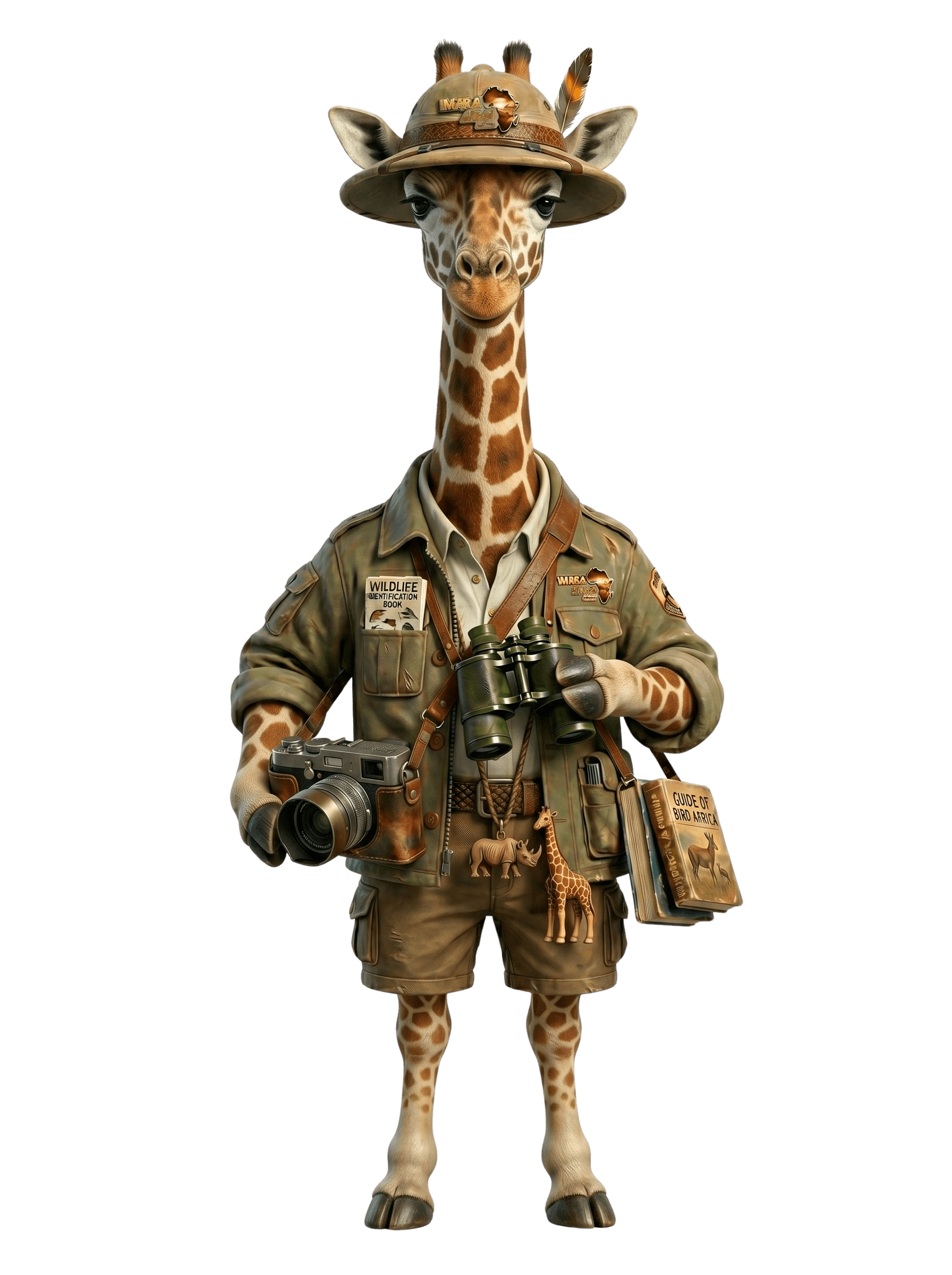
Earth's Tallest Animal
Standing up to 5.8 metres (19 ft) tall, the giraffe is the tallest living terrestrial animal. Their extraordinarily long necks — which contain the same 7 vertebrae as humans, just much larger — evolved for reaching high browse that no other herbivore can access.
Unique Adaptations
Giraffes possess remarkable cardiovascular adaptations. Their hearts weigh approximately 11 kg and generate nearly twice the blood pressure of other large mammals to pump blood up to their brain. Special valves in their neck arteries prevent dangerous blood surges when they bend down to drink.
Patterns & Species
Every giraffe's coat pattern is unique — like a fingerprint. Recent genetic research has identified four distinct giraffe species: Northern, Southern, Reticulated, and Masai. The Masai giraffe, found in Kenya and Tanzania, has distinctive jagged, leaf-shaped patches.
Social Life
Giraffes live in loose, open herds with no fixed membership — a social system called "fission-fusion". Males establish dominance through "necking" — a sparring behaviour where they swing their heavy heads and necks at each other. Despite looking gentle, these blows can be devastating.
Conservation
Giraffe populations have declined by approximately 40% over the past 30 years, a crisis conservationists call a "silent extinction". From an estimated 155,000 in 1985, numbers have fallen to roughly 117,000 today. Habitat loss and poaching are the primary threats.